


How to fix lost formwork and everything you need to know about it
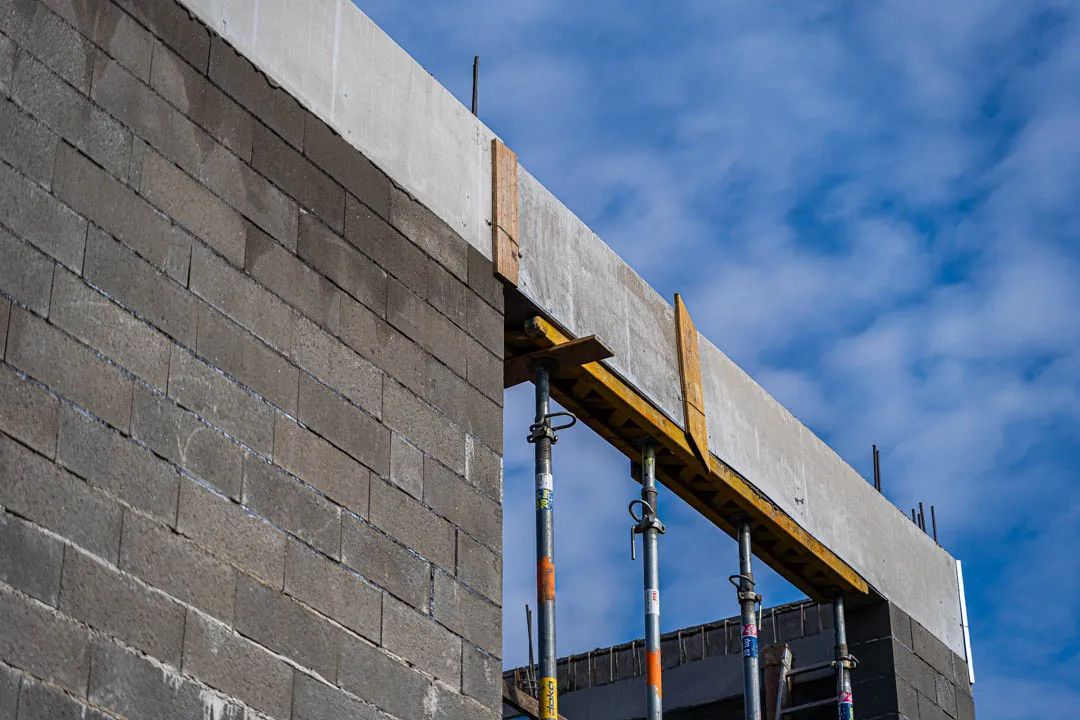
Lost formwork is gaining more and more popularity among builders due to its simplicity and practical advantages. Time savings, cost reductions and significantly easier assembly that even a beginner can handle make it an attractive alternative to traditional methods. While classic wooden or metal formwork requires complex assembly and subsequent disassembly, lost formwork becomes a permanent part of the structure and greatly simplifies the entire construction process.
In this comprehensive guide you will learn not only what is lost formwork and how to apply it, but also practical assembly procedures, selection of the right dimensions and materials including recommended CEMVIN cement-fibre boards.
What is lost formwork and where is it used
Lost Formwork is a construction technology where a mold intended for pouring concrete remains a permanent part of the structure after its hardening — literally “lost” in it. Unlike the classic formwork, which must be dismantled after the concrete hardens, the lost formwork performs the function of both a form and a structural element of the finished structure.
Foundations of Lost Formwork consist in the simple principle of folding standardized elements on top of each other using a pen-groove system. This system works as a kit and allows quick assembly even for less experienced builders.
It is most often used for lost formwork foundation houses, retaining walls, baseboards and foundation. An interesting application finds lost formwork in the slope, where it helps to level the terrain and create stable structures.
Materials and dimensions for different applications
Concrete blocks — the traditional solution
Dimensions of lost formwork for classic concrete blocks are standardized: length 500 mm, height 250 mm. How wide lost formwork depends on the specific use:
- 100—150 mm: lighter walls, partitions
- 200—250 mm: standard foundations of detached houses
- 300—400 mm: more massive construction, retaining walls
- 450—500 mm: heavy foundations, industrial buildings
CEMVIN plates — modern alternative
CEMVIN cement fibreboards represent an innovative solution with a number of advantages over traditional blocks. For ground construction it is used CEMVIN FORM in thicknesses of 4—10 mm, while for bridges and technically demanding structures it serves CEMVIN BRIDGE with thicknesses of 15—30 mm. The standard format of both variants is 2500×1200 mm.
Key Features:
- Fire Response Class A1 ---- non-flammable
- Frost resistance and water resistance
- High mechanical resistance
- Versatile finish ready for plastering or painting
- Eco-friendly production process Asbestos-free
Step by step: how to build a lost formwork
Preparation of the foundation
Founding lost formwork correctly determines the quality of the entire structure. The excavation of the foundation strips must reach a frost-free depth of at least 800 mm. A gravel backfill of 100 mm is laid on the bottom, which is compacted.
A critical step is the concreting of the underlying concrete slab with a thickness of 80-120 mm from C16/20 concrete. The foundation under the lost formwork must be perfectly aligned -- any inaccuracy is repeated in all higher ranks.
Assembly and reinforcement
Installation of lost formwork starts at the highest point of the foundation. How to lay lost formwork right?
- First row is laid in fresh cement mortar for leveling
- It starts in the corners — divisible blocks are used
- Other series are folded dry by means of a locking connection
- Check the verticality and horizontality each row
Reinforcement takes place simultaneously with the composition:
- Vertical reinforcement passes through the entire height and anchors to the foundation
- Horizontal reinforcement is inserted into the cutouts in the blocks
- The diameter is determined by the designer according to a static calculation
Concreting
How to concretize lost formwork?
A thin mixture of S3 consistency is used for easy flow of concrete into the formwork.
How to fill the lost formwork?
It depends on the type — for foundations concrete C20/25, for less stressed structures C12/15.
Concreting in progress by layers — a maximum of 7 rows at a time. Compaction is key:
- Piercing of reinforcing bars
- Immersion vibrator in layers 30—40 cm
- Tapping to release air bubbles
Concrete consumption for lost formwork?
A block with a width of 300 mm consumes about 150-180 liters of concrete per running meter.
Practical tips and the most common mistakes
Cutting and editing
How to cut lost formwork?
Concrete blocks are cut with an angle grinder with a diamond disc. CEMVIN plates will be delivered to you formatted directly according to your project.
Finishes
Plastering the lost formwork is not complicated, but requires proper preparation. The most important thing is the installation of waterproofing under the structure, which will prevent the appearance of moisture and later problems with the plaster. In addition, CEMVIN plates have a universal surface prepared for all types of finishing works.
The 5 most common mistakes
- Incorrect selection of dimensions — For example, the use of 200 mm blocks on a heavy retaining wall — can lead to cracking. Always let the design be handled by statics
- Insufficient compaction — Poorly compacted concrete has lower strength and contains voids. Compress systematically in layers with a vibrator.
- Forgotten waterproofing — Without insulation under the wall, efflorescences and moisture will appear on the plaster. Always install asphalt strips or coatings.
- Poor alignment of the first row — An error of 5 mm in the first row may indicate a 20 mm deflection in the fourth row. Pay maximum attention to leveling the foundation.
- Incorrect reinforcement — For example, forgotten horizontal reinforcement in the corners can cause cracks. Strictly follow the project documentation
Economic benefits and CEMVIN solutions
Cost calculation
Price for work when using lost formwork is often lower due to faster assembly. Time saving reaches
30-50% compared to traditional methods. Formwork volume lost for orientation: foundation strip 1 m high width
300 mm consumes 4 blocks and 150-180 liters of concrete per ordinary meter.
Advantages of CEMVIN
CEMVIN cement-fiber boards offer:
- Appearance of visible concrete immediately after implementation
- Non-flammability and fire protection
- High load capacity for demanding applications
- Technical support From Design to Implementation
- Custom Formatting according to the project
Economic efficiency
The cost of work when using lost formwork is often lower due to faster assembly and the absence of dismantling. Practically, this means a time saving of 30-50% compared to traditional methods. For an indicative calculation: a foundation strip with a height of 1 meter and a width of 300 mm consumes 4 blocks and 150-180 liters of concrete per ordinary meter.
Why choose CEMVIN plates?
CEMVIN fiber cement slabs bring a number of specific advantages that distinguish them from conventional concrete blocks. Immediately after implementation, you get the appearance of visible concrete without the need for additional modifications. Thanks to the flammability class A1, they provide effective fire protection and their high load capacity allows them to be used even in technically demanding applications.
A significant advantage is the comprehensive service — from technical design support to the delivery of boards formatted exactly according to the requirements of your project.
Conclusion
Lost formwork is no longer a problem — with the right procedures and quality materials, you will achieve professional results. The key to success is careful preparation, quality materials and adherence to technological procedures.
Modern CEMVIN plates take the possibilities of lost formwork to a new level by combining ease of application, excellent technical parameters and aesthetic qualities.
Planning a project with lost formwork? Contact us for expert consultation and design of the optimal solution tailored to your needs.
